
Microplastic Analysis

Plastic products are utilized extensively in daily life, including food packages, household items to construction materials and automobile components. However, improper disposal of plastic products leads to their release into the environment. The released plastics deteriorate gradually in the environment, due to the mechanical forces of waves and winds, photodegradation by ultraviolet light radiation, and thermal degradation by heat, and are fragmented into smaller particles known as microplastics (MPs, particle size 5 mm-1 µm) and nanoplastics (NPs, particle size less than 1 µm). Environmental pollution by microplastics and nanoplastics (MNPs) is now pervasive, spreading through ocean currents and atmospheric circulation into the hydrosphere, and pedosphere. Microfibers (MFs) and tire and road wear particles (TRWP) are also types of MNPs, which are formed by the shedding of synthetic textiles during washing and by the friction of car tires with road surfaces, respectively, and are released directly released into the environment.

Environmental MNPs often contain, in addition to the primary polymer component, various additives that impart specific functionalities to plastic products, as well as persistent organic pollutants that adsorb to their surfaces. MNPs are known to be ingested by a wide variety of organisms. In addition to direct ingestion, MP contamination spreads through the ecosystem via the food chain, raising concerns about potential impacts on human health.
There is a continued need for surveys and research to accurately determine the types and quantities of MNPs present in the environment. Although numerous studies have been reported and data and knowledge on MNPs have been accumulated, comprehensive understanding of the issue remains unclear. Further investigations are necessary to assess both the presence (qualitative and quantitative) and ecological impact of MNPs, and to implement effective mitigation strategies.
Analytical methods for microplastics
Comprehensive evaluation of environmental pollution from MPs requires both qualitative and quantitative analyses of MP particles. Two principal analytical approaches are commonly employed: spectroscopic analysis and thermal analysis. While both are capable of qualitative characterization, quantitative assessment in spectroscopic methods, such as micro-infrared spectroscopy and micro-Raman spectroscopy, is based on counting MP particles. In contrast, the thermal analysis technique, pyrolysis GC/MS, analyzes MPs based on mass and offers the advantage of simultaneously performing both qualitative and quantitative analysis of additives present in MP particles.
Features of pyrolysis GC/MS
Pyrolysis (Py)-GC/MS is a powerful technique capable of directly analyzing solid or liquid samples to determine their composition and chemical structure. It is particularly effective for polymer samples containing insoluble and infusible polymers, as well as three-dimensional cross-linked structures. Because measurements can be performed at the microgram level without any pretreatment, Py-GC/MS provides unique insights that are often unattainable with other analytical techniques, making it indispensable for polymer characterization. Consequently, Py-GC/MS is also extremely effective for the analysis of MPs. For additional details on the Py-GC/MS method, please refer to this link.
Microplastic analysis by Py-GC/MS
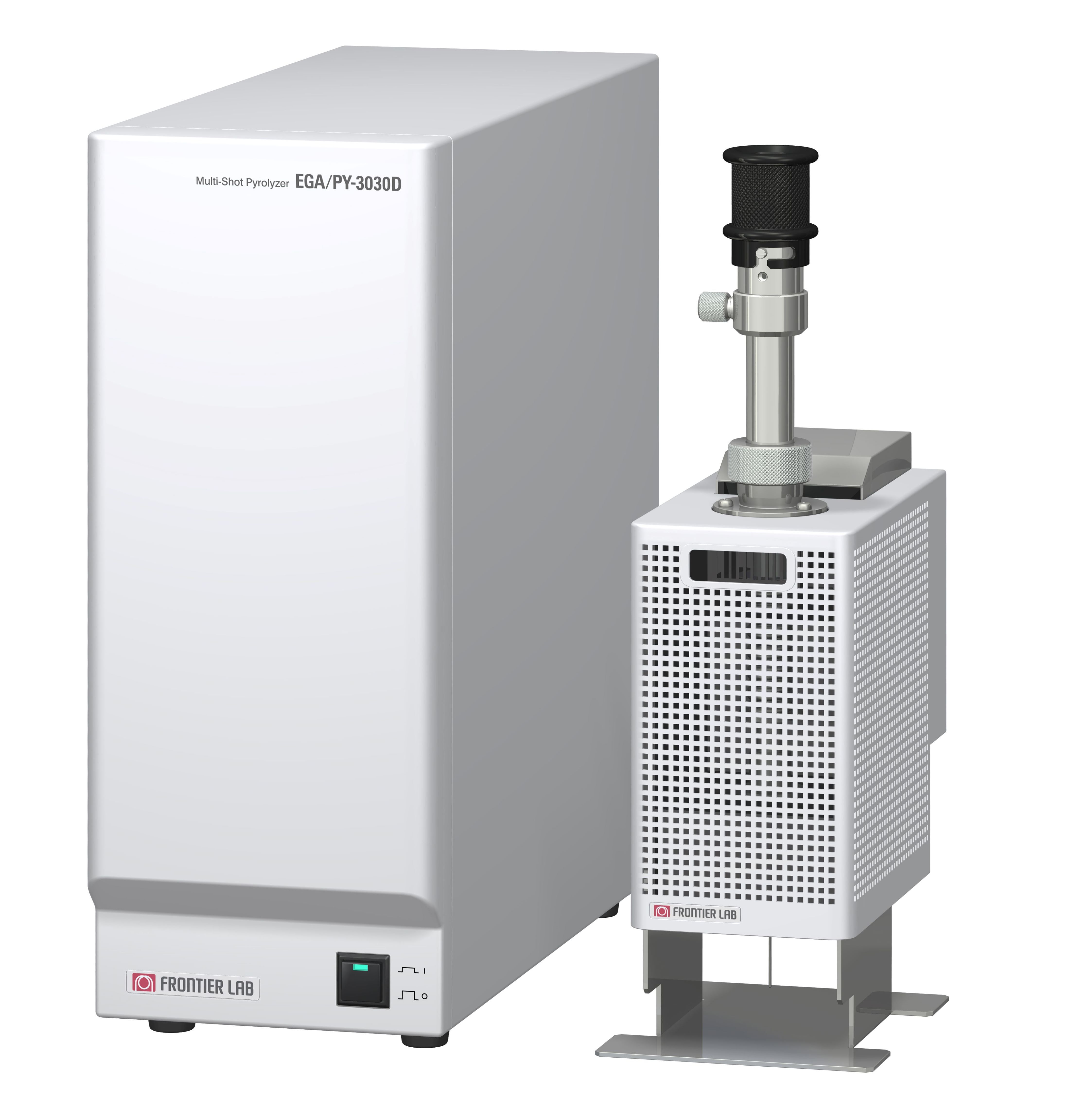
For more than 30 years, Frontier Lab has been a leader in polymer analysis, building up extensive expertise in pyrolysis GC/MS. Our capabilities span from the development of analytical instruments to the proposal of comprehensive solutions. A key strength lies in our ability to create products that integrate advanced technology with practical, on-site requirements. Centered on high-performance micro-furnace pyrolyzers, we offer a comprehensive product lineup that covers the entire analytical workflow, from sample collection to final data analysis.
Our microplastic analysis solution is specifically designed for the qualitative and quantitative evaluation of MPs in environmental samples. It provides a fully integrated workflow that includes a dedicated sampling device for efficient MP collection from water, a Py-GC/MS system, and specialized analysis software. At its core, the Py-GC/MS system is optimized for high sensitivity and precision, delivering highly reliable data for microplastic analysis.
In addition, the system is designed with a strong focus on operability, ensuring ease of use for both experienced analysts and those new to MP analysis. Dedicated analysis software enables rapid processing of measurement data, and each measurement can be completed in approximately 30 minutes per sample, supporting the development of an efficient workflow.

System diagram of Frontier Lab’s MP analysis solution
Video: Microplastic analysis using Pyrolysis GC/MS System
MP analysis method specified by ASTM
The ASTM International website has published ASTM D8401-24, Standard Test Method for the Qualitative and Quantitative Analysis of Microplastics in Water Using Pyrolysis-Gas Chromatography/Mass Spectrometry (Py-GC/MS). For details on this method, please visit the ASTM.org website.
Frontier Labs’ Py-GC/MS system for microplastic analysiscomplies with this ASTM standard. This system includes all necessary hardware for microplastic analysis as well as software for qualitative and quantitative evaluation.
MP analysis related products

Smart Fine Particle Collector
(SFPC)This device features a collection cup with a newly designed inert metal filter, enabling the direct vacuum filtration of MPs larger than 5 μm in size from clean water. The collected sample can immediately be used for Py-GC/MS measurement, minimizing the need for pretreatment.

F-Search MPs 2.1
The unique search algorithm makes it easy for anyone, even those users with minimal experience in polymer analysis, to perform accurate identification and quantification of 12 types of MPs.

Multi-Functional Splitless Sampler
(MFS-2015E)This device supports splitless pyrolysis and backflush. Splitless pyrolysis enables high-sensitivity analysis of trace polymers and low-concentration additives in polymers. The backflush function reduces analysis time and system contamination.

MP calibration standard set
This product is used for qualitative and quantitative analysis of 12 polymers using Py-GC/MS. It allows for easy creation of calibration curves for MP quantification. To facilitate weighing on a semi-microbalance, SiO2 and CaCO3 are used as diluents, with each polymer included in quantities of only a few micrograms.

Cryogenic grinder IQ MILL-2070
This compact, user-friendly desktop grinder is designed for rapid sample grinding and supports both room temperature and cryogenic grinding (pre-cooling method). By homogenizing samples, it enhances the reproducibility and reliability of measurement results.
More


Learn more about MP analysis in these videos.
These videos provide insights into MP analysis. (Login required to view.)
Quantification & Identification of Microplastics in Air Using Pyrolysis-GC/MS
This seminar focuses on the analysis of MPs found in the atmosphere. It introduces the configuration and specifications of a Py-GC/MS system optimized for qualitative and quantitative analysis of MPs. It also explains examples of qualitative and quantitative analysis of MPs in the atmosphere using a Py-GC/MS system.
You Can’t Manage What You Can’t Measure
This seminar focuses on the issue of MPs found in the environment. It introduces methods for analyzing MPs in air, water, and soil samples. It also explains how Py-GC/MS is an effective method for qualitative and quantitative analysis of MPs.